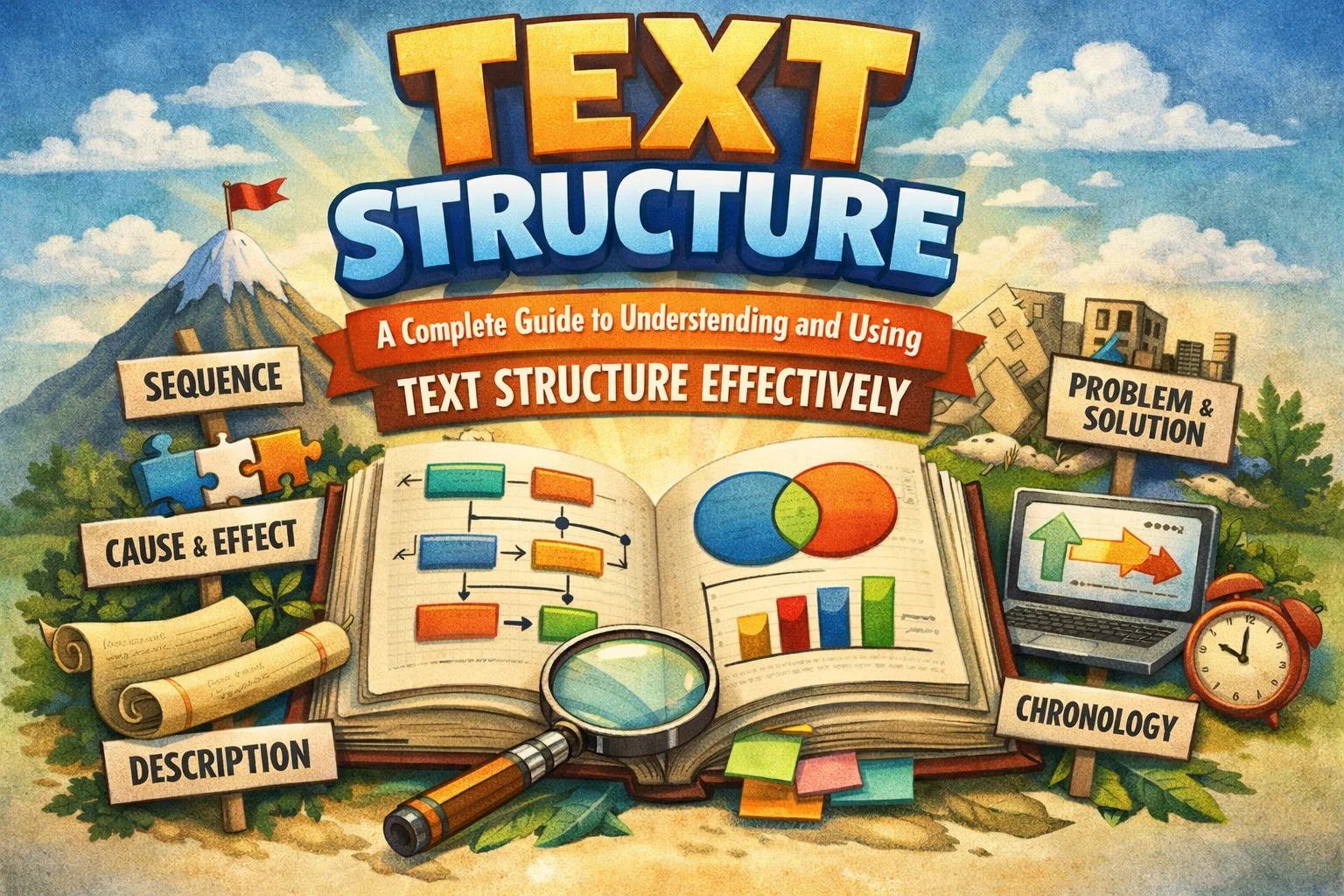
When we read any piece of writing, we don’t just look at words—we follow a pattern. That pattern is called text structure. Understanding text structure helps readers make sense of information quickly and clearly. It also helps writers present ideas in an organized way.
In this detailed guide, you’ll learn everything about text structure—what it is, why it matters, its types, examples, and how to use it like an expert. Whether you’re a student, teacher, or writer, this article will give you the tools you need to succeed.
What Is Text Structure?
Text structure refers to the way information is organized in a piece of writing. It’s like a blueprint or map that guides the reader through the text.
In simple words, text structure answers this question:
👉 How is the information arranged?
Writers use different types of text structure depending on their purpose. For example, they might want to tell a story, explain a problem, or compare ideas.
Why Text Structure Is Important
Understanding text structure is very important for both readers and writers. Let’s break it down.
For Readers
- Helps understand the main idea quickly
- Makes it easier to remember information
- Improves reading comprehension
- Helps identify key details
For Writers
- Organizes ideas clearly
- Makes writing more engaging
- Helps deliver messages effectively
- Keeps readers interested
In short, text structure is the backbone of good writing.
Common Types of Text Structure
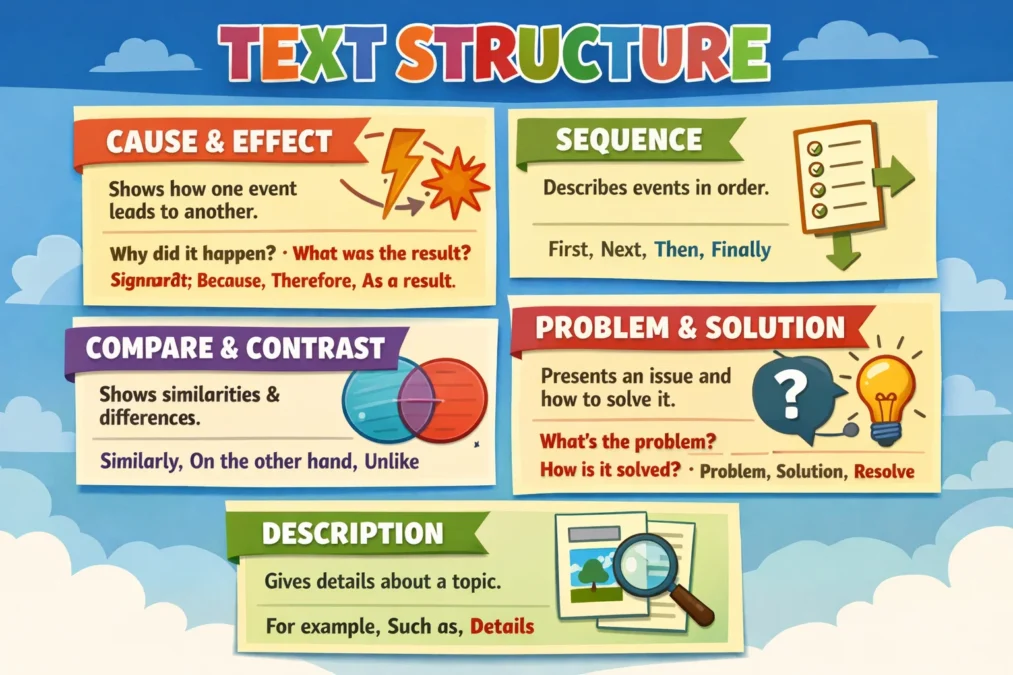
There are five main types of text structure that are widely used in writing. Let’s explore each one.
Description Text Structure
The description text structure is used to explain or describe something in detail. It gives readers a clear picture of a topic.
Key Features
- Focuses on one topic
- Uses sensory details
- Includes examples and facts
Signal Words
- for example
- such as
- including
- characteristics
Example
“A tiger is a large wild animal with orange fur and black stripes. It has sharp teeth and strong legs.”
This type of text structure helps readers imagine the subject clearly.
Sequence Text Structure
The sequence text structure shows events or steps in order. It is often used in instructions or stories.
Key Features
- Follows a specific order
- Can be time-based or step-based
Signal Words
- first
- next
- then
- finally
Example
“First, boil water. Next, add tea leaves. Then, pour into a cup. Finally, enjoy your tea.”
This text structure is very helpful for instructions and processes.
Compare and Contrast Text Structure
The compare and contrast text structure shows similarities and differences between two or more things.
Key Features
- Highlights similarities
- Explains differences
Signal Words
- similarly
- however
- on the other hand
- both
Example
“Cats are independent, while dogs are more social. Both animals make great pets.”
This type of text structure helps readers understand relationships between ideas.
Cause and Effect Text Structure
The cause and effect text structure explains why something happens and what happens as a result.
Key Features
- Shows reasons and outcomes
- Explains relationships
Signal Words
- because
- therefore
- as a result
- due to
Example
“It rained heavily, so the streets were flooded.”
This text structure helps explain events clearly.
Problem and Solution Text Structure
The problem and solution text structure presents an issue and suggests ways to fix it.
Key Features
- Identifies a problem
- Offers one or more solutions
Signal Words
- problem
- solution
- challenge
- resolve
Example
“Plastic waste is harming the environment. One solution is to reduce plastic use and recycle more.”
This text structure is useful for discussions and essays.
Table of Text Structure Types
Here’s a simple table to summarize the main types of text structure:
| Text Structure Type | Purpose | Signal Words | Example Use |
|---|---|---|---|
| Description | Explain or describe | such as, for example | Describing animals |
| Sequence | Show order or steps | first, next, finally | Recipes, instructions |
| Compare and Contrast | Show similarities/differences | however, similarly | Comparing products |
| Cause and Effect | Show reasons and results | because, therefore | Explaining events |
| Problem and Solution | Present issue and fix | problem, solution | Essays, reports |
How to Identify Text Structure
Sometimes, identifying text structure can feel tricky—but don’t worry, it gets easier with practice.
Look for Signal Words
Signal words are clues that tell you the type of text structure.
Check the Purpose
Ask yourself:
- Is the text describing something?
- Is it explaining steps?
- Is it comparing ideas?
Analyze the Organization
Look at how the ideas are arranged. That will reveal the text structure.
Tips for Using Text Structure in Writing
Want to improve your writing? Here are some simple tips for using text structure effectively:
Plan Before Writing
Think about your purpose and choose the right text structure.
Use Clear Signal Words
They guide the reader and make your writing easier to follow.
Stay Organized
Stick to one text structure at a time to avoid confusion.
Revise Your Work
Check if your ideas flow smoothly and match the chosen text structure.
Common Mistakes to Avoid
Even experienced writers sometimes make mistakes with text structure. Here are a few to watch out for:
- Mixing different structures without clarity
- Using weak or no signal words
- Jumping between ideas
- Not following a clear order
Avoiding these mistakes will make your writing stronger.
Real-Life Uses of Text Structure
You might be surprised, but text structure is everywhere!
In School
- Essays
- Textbooks
- Assignments
In Daily Life
- Recipes (sequence)
- News articles (cause and effect)
- Reviews (compare and contrast)
In Professional Writing
- Reports
- Emails
- Presentations
Understanding text structure gives you an edge in all these areas.
How Teachers Use Text Structure
Teachers often use text structure to help students learn better.
Classroom Activities
- Identifying structures in passages
- Writing exercises
- Group discussions
Benefits for Students
- Better reading skills
- Stronger writing abilities
- Improved critical thinking
It’s safe to say that mastering text structure can boost academic success.
Fun Ways to Practice Text Structure
Learning text structure doesn’t have to be boring!
Try These Activities
- Write your daily routine (sequence)
- Compare two favorite foods (compare and contrast)
- Describe your best friend (description)
- Explain why plants need water (cause and effect)
- Suggest ways to reduce pollution (problem and solution)
These fun exercises make learning text structure enjoyable and effective.
Final Thoughts on Text Structure
To wrap it all up, text structure is a powerful tool that helps both readers and writers. It organizes ideas, improves understanding, and makes communication clear and effective.
By learning the different types of text structure—like description, sequence, compare and contrast, cause and effect, and problem and solution—you can read smarter and write better.
So, the next time you pick up a book or start writing, pay attention to the text structure. Once you master it, everything else falls into place—and trust me, it makes a world of difference!