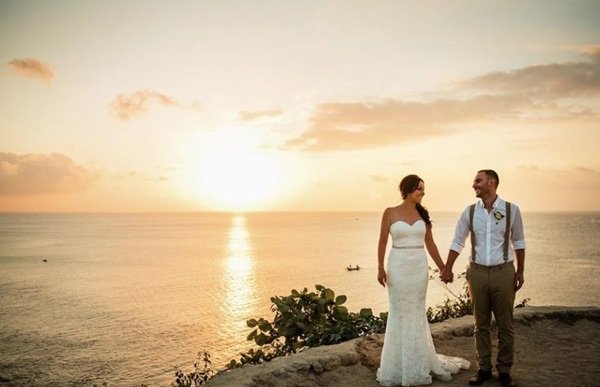
A friend who got married in Santorini three years ago described the planning process as “a part-time job that occasionally became a full-time emergency.” She said it not as a complaint but as a warning — specifically directed at a colleague who had just announced plans to get married in Bali and was confidently describing how manageable it all seemed from the outside. The colleague nodded politely and proceeded to discover, over the following fourteen months, exactly what her friend meant. Not because anything went catastrophically wrong, but because the cumulative weight of coordinating an international event from another country, across multiple time zones, with suppliers operating in a different business culture, is consistently heavier than it appears at the planning stage when everything still exists only as ideas and possibilities.
The first thing worth understanding about planning a wedding overseas is that the skills required are meaningfully different from those required to plan any other type of event. Organizational ability helps. Attention to detail helps. But what destination wedding planning specifically demands is comfort with uncertainty, patience with communication delays, and the ability to make consequential decisions based on incomplete information about places, people, and conditions you haven’t personally experienced. Couples who struggle most with the process are typically those who need high certainty before they can move forward — because destination wedding planning involves a sustained period of lower certainty than most people are prepared for, and the tools for managing that uncertainty are not obvious until you’ve encountered them.
For couples in the research phase, finding reliable wedding ceremony abroad costs that go beyond generic advice about “starting early” and “setting a budget” requires looking at sources with genuine operational experience rather than content written to attract search traffic. The practical insights that actually change how couples approach the process tend to come from planners who have spent years solving real problems in specific destinations, and from couples who have been through it and are willing to be honest about what surprised them. Both sources consistently emphasize the same themes: the importance of local expertise, the underestimation of communication complexity, and the gap between how a supplier presents online and how they perform under pressure.
Contracts deserve more attention than most couples give them during the planning process, particularly for destination weddings where enforcement is complicated by geography and jurisdiction. Every supplier agreement should specify exactly what is included, what constitutes a cancellation, what the refund policy is under various scenarios, and what happens if the supplier is unable to fulfill their obligations. These clauses feel unnecessarily pessimistic when everything is going smoothly in the early planning stages. They become extremely relevant when a photographer has a family emergency two weeks before the wedding, or when a venue changes ownership and the new management doesn’t honor previous bookings at the agreed rate. Reading contracts carefully — or having someone with local knowledge read them on your behalf — is one of the least glamorous and most important things a couple can do during the planning process.
Payment structure is another practical area where destination weddings introduce complications that local weddings don’t. Sending significant deposits to suppliers in another country via international bank transfer involves fees, exchange rate exposure, and a level of financial risk that warrants careful thought. Understanding which payment methods offer recourse if something goes wrong — and which simply transfer money with no protection — matters more than most couples realize until they need to recover a deposit from a supplier who has gone out of business or failed to deliver. Paying in stages tied to specific milestones, rather than large upfront sums, reduces exposure without creating friction in supplier relationships when handled professionally.
Site visits are consistently undervalued by couples planning destination weddings, particularly for destinations like Bali where the gap between how a venue photographs and how it actually functions can be substantial. A venue that looks extraordinary in a portfolio might have a catering kitchen that is genuinely too small for the guest count, ambient noise from a nearby road that doesn’t register in photographs, or a sunset orientation that puts the ceremony party directly into harsh backlight during the critical hour. None of these things are visible remotely. A single visit, timed to match the approximate conditions of the wedding day, resolves questions that months of email correspondence cannot. For couples who genuinely cannot travel before the wedding, a trusted local planner conducting a thorough site assessment with video documentation is the next best option — but it is the next best option, not an equivalent one.
The single most consistent piece of advice that emerges from couples who navigated destination wedding planning successfully — and who would genuinely do it the same way again — is to invest in local professional support earlier than feels necessary. The instinct to handle as much as possible independently, to treat professional planning support as something to add later if things get complicated, consistently produces a harder planning experience and a higher risk of day-of problems than simply starting with the right support structure in place. The couples who find the process genuinely manageable are those who recognized early that planning a wedding in another country is a different undertaking than planning one at home, and structured their approach accordingly — rather than discovering that reality gradually, through a series of increasingly stressful experiences, over the course of more than a year.